Judges 16:28 — The Prayer of Samson
“And Samson called unto the LORD, and said, O Lord GOD, remember me, I pray thee, and strengthen me, I pray thee, only this once, O God, that I may be at once avenged of the Philistines for my two eyes.” (Judges 16:28)
The prayer of Samson, uttered from a place of blindness, humiliation, and deep personal regret, is one of the most profound prayers in all of Scripture. It is short, it is raw, it is desperate—but it is also deeply revelational. Samson’s final prayer is not simply the cry of a fallen man; it is the cry of a man who finally understands that strength is not a personal asset but a divine trust. It is the cry of a man who recognizes that calling does not expire because of failure. It is the cry of a man whose destiny, though wounded, is still recoverable when placed in the hands of God.
Samson’s life was marked by supernatural beginnings. His birth was announced by an angel (Judges 13:3). He was set apart as a Nazarite from the womb. The Spirit of the Lord moved upon him from his youth. His strength was not genetic—it was divine. Yet somewhere in the journey, Samson began to rely more on the gift than the Giver. He played with temptation. He entertained compromise. He mismanaged his assignment. And eventually, he fell into the hands of those he was born to defeat.
When Delilah betrayed him and his hair was cut, Scripture says, “But he did not know that the Lord had departed from him” (Judges 16:20). That is one of the saddest sentences in the Bible—the anointed man did not know he was empty. He assumed the presence he neglected would still remain. But grace cannot be taken for granted. Destiny cannot be handled carelessly. Samson learned too late that strength without obedience is dangerous and calling without consecration is fragile.
Yet the story does not end in defeat. Samson is taken to Gaza—bound, blinded, and broken. But Judges 16:22 inserts a quiet, hopeful whisper: “However, the hair of his head began to grow again…” This is the mercy of God. His hair growing again was not just biology—it was prophecy. It was a sign that God was not finished. It was restoration disguised as silence. It was the return of possibility.
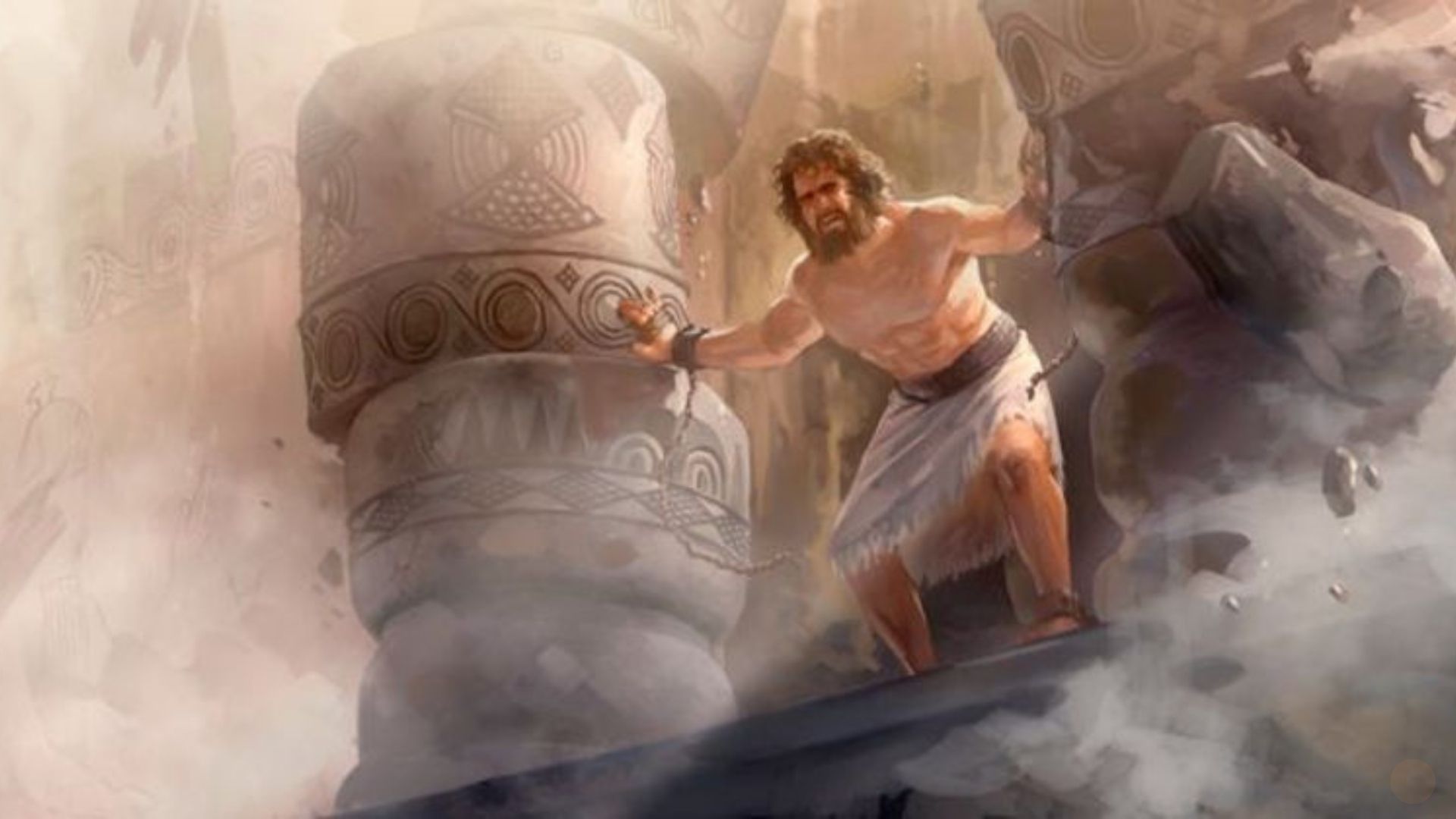
Samson’s final prayer is birthed from this place of humility. Standing between the pillars of the enemy’s temple, mocked by those he was destined to rule over, Samson finally prays the prayer he had never prayed before. Not a prayer of pride. Not a prayer of performance. Not a prayer of showmanship. But a prayer of dependence.
He says, “O Lord GOD, remember me…”
This is the cry of someone who has realized that life without God’s attention is aimless. “Remember me” is not reminding God of something forgotten; it is asking God to turn His face toward you again. It is the same cry the thief on the cross prayed: “Lord, remember me when You come into Your kingdom” (Luke 23:42). When God remembers you, destiny reawakens.
Then Samson prays, “Strengthen me, I pray, just this once.”
This is the first time Samson asks God for strength. Before this moment, Samson always acted without praying. He tore lions apart, broke ropes, carried city gates—not once did Scripture record him praying for power. He assumed the anointing was automatic. But brokenness taught him dependence. Blindness taught him surrender. Captivity taught him humility. Now the man who once acted on impulse finally learns to ask.
Samson’s prayer shows that even if you wasted years, God can still use moments. Even if you failed in your strength, God can redeem you in your weakness. Even if your destiny seems lost, God can breathe on it again. Judges 16:28 reveals a spiritual truth: a repentant heart can accomplish in one moment what pride could not accomplish in a lifetime.
In his death, Samson achieved more than he ever did in his life (Judges 16:30). God allowed Samson’s final act to bring justice against the Philistines, the very enemy nation he was born to confront. What he could not accomplish through years of compromise, he accomplished through one moment of surrendered prayer.
Samson’s prayer teaches that restoration is possible even after failure. No mistake exempts you from mercy. No fall is too deep for grace. No defeat is too final for God. Samson’s eyes were gone, but his destiny was not. Samson’s reputation was damaged, but his calling still carried weight. Samson’s strength had left him, but God had not. He was humbled, but not abandoned. Broken, but not rejected.
Samson’s story reminds us that God often uses broken vessels to release His greatest glory. Psalm 51:17 says, “A broken and contrite heart—these, O God, You will not despise.” When Samson broke, God responded. When Samson surrendered, God strengthened. When Samson prayed, God moved.
The prayer of Samson is also a prophetic warning. It shows that gifts can be lost through carelessness, that intimacy can be weakened through compromise, and that destiny can be delayed by disobedience. Samson teaches us that the enemy does not fear your strength—he fears your consecration. Delilah could not cut Samson’s hair until Samson first cut his covenant. The attack on your destiny always begins with the attack on your consecration.
Yet above all, Samson’s prayer is a message of hope—a reminder that God restores. God remembers. God renews. God revives. God gives second chances. God rewrites stories. God can turn a fallen judge into a victorious finisher. God can take a man whose eyes were gouged and still let him see destiny clearly. God can take a person whose story looked over and make the final chapter the most impactful one.
Samson prayed at the end—but God answered at the beginning of a new purpose. His final breath became his greatest victory. His final prayer became his greatest revelation. His final act became his greatest fulfillment.
And this truth remains for every believer:
It is never too late to pray, “Lord, remember me… strengthen me… just once more.”
Because one moment of God’s strength can redeem years of human weakness.